
Digital Twins are virtual representations of real-world physical objects, systems, or processes, created to simulate, monitor, and predict the behavior of these elements under various conditions. These digital representations are fed by real-time data collected from sensors and other devices connected to the physical object, enabling dynamic interaction between the physical and digital worlds.
The idea behind Digital Twins is to create an exact copy of an object or system in a virtual environment, where it is possible to conduct tests, simulations, and analyses without directly interfering with the actual object or system.
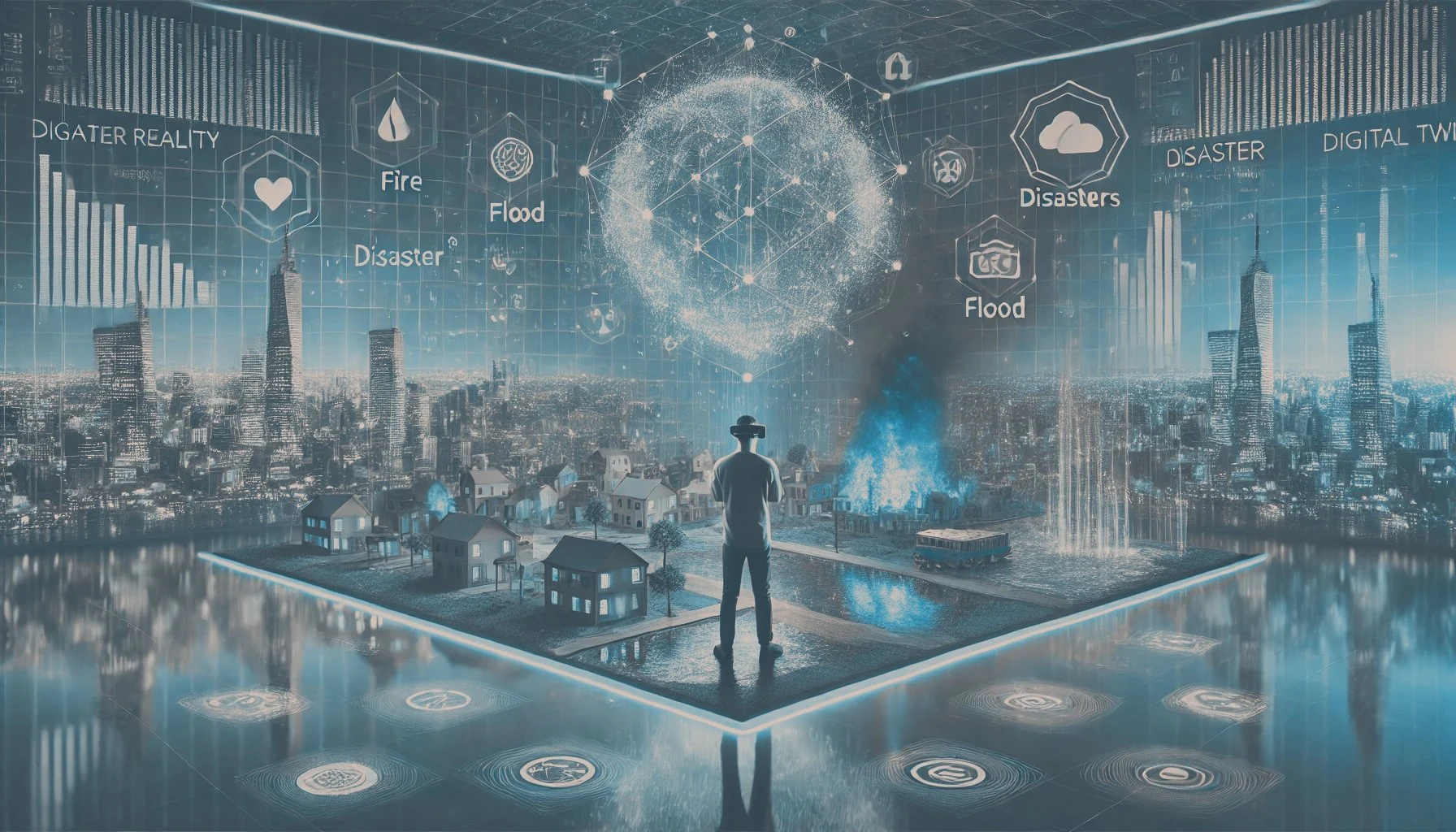
Their use is generally based on VR (virtual reality) technologies, which provide an immersive experience, allowing users to interact with a three-dimensional digital environment as if they were physically present—enabling detailed and interactive visualization of digital models of real objects or systems.[1] Undoubtedly, the relationship between Digital Twins and virtual reality is symbiotic, since the power of simulation and data analysis is amplified by the immersion and interactivity provided by immersive virtualization. Together, these technologies are shaping the future of how we interact, plan, and make decisions in complex environments, from industry to medicine and beyond.
In Japan, where this field first emerged, Digital Twins are fundamental to the development of smart cities. For example, in cities like Tokyo and Yokohama, they are used to create virtual models of urban infrastructure, including transportation systems, energy grids, and buildings.[2] These models enable the monitoring and optimization of energy efficiency, traffic flow, and responses to natural disasters, such as earthquakes and floods. Engineering firms in Japan use Digital Twins to plan and manage large infrastructure projects, such as the construction of bridges, highways, and railroads. Furthermore, the Japanese automotive industry—which includes giants like Toyota and Nissan—uses these technologies to simulate the entire life cycle of vehicles. From the design and development phase through mass production, Digital Twins help optimize performance, the efficiency of manufacturing processes, and vehicle maintenance.[3]
However, for the purposes of this brief essay, it is worth noting that, given the high risk of natural disasters in Japan—such as earthquakes and tsunamis—Digital Twins are used to model disaster scenarios and test response strategies. This includes evacuation simulations and the optimization of emergency resources, improving the resilience of cities and communities and enabling the government to effectively mitigate risks.
Such risks, according to Romualdo Baptista dos Santos, “are related to the process of modernizing life in society, whether due to human interference with nature, the performance of activities necessary for our way of life, or the exclusion of large segments of the population from the civilizing process.”[4]
Undoubtedly, the Japanese example of Digital Twins allows us to rethink the applicability of virtual reality technologies for risk mitigation in large cities and urban agglomerations, including for the prevention of major environmental disasters. And, as is widely known, in 2024, in Brazil, the state of Rio Grande do Sul faced one of the greatest climate-related catastrophes in its history due to major floods that occurred between April and May.[5] These floods were caused by a combination of extreme weather factors, including intense and prolonged rainfall, exacerbated by the El Niño phenomenon and the lack of adequate infrastructure to handle large volumes of water in several cities across the state.[6]
The floods caused extensive damage throughout Rio Grande do Sul, affecting more than 2 million people in 446 municipalities. Porto Alegre was one of the hardest-hit cities, with entire neighborhoods submerged, while other cities such as Caxias do Sul and Santa Maria also suffered significant damage.[7] The rains resulted in the displacement of hundreds of thousands of people, the destruction of critical infrastructure,[8] and significant economic losses, especially in the agricultural sector, in addition to raising various questions about insurance and its implications regarding the limits of coverage for such cases.[9]
In addition, there was a serious impact on public health, with an increase in cases of waterborne diseases, such as leptospirosis and dengue fever. The response to the floods involved emergency efforts by the government, nongovernmental organizations, and civil society, but full recovery is seen as a process that will require considerable time and resources.
These 2024 floods were compared to other historic events in the state, such as the floods of 1941 and 2023, but were notable for their intensity and the challenges they posed to infrastructure and disaster management in the region.[10]
Undoubtedly, the use of Digital Twins to map risks and prevent natural disasters, such as the floods that occurred in Rio Grande do Sul in 2024, can be a highly effective strategy, given the ability of these virtual models to simulate and predict complex scenarios.
Some specific ways this technology could be applied would involve creating virtual models of flood-prone regions, integrating real-time meteorological data with historical flood records. These models can simulate different scenarios of heavy rainfall and predict how drainage systems, rivers, and other urban infrastructure would respond to such events, which would allow authorities to identify high-risk areas and take preventive measures, such as reinforcing dams or constructing drainage channels.
Furthermore, by integrating sensors in critical areas, Digital Twins can provide continuous monitoring of local conditions, such as river levels, soil saturation, and the performance of drainage infrastructure. This enables the early detection of anomalies that may indicate a risk of flooding, allowing for a rapid and coordinated response, such as the preventive evacuation of vulnerable areas.
Such virtual reality models can also be used to assess the impacts of new construction or changes to urban infrastructure on a region’s ability to cope with extreme events. For example, before approving a new construction project at the municipal level, the models can simulate how that development would affect water runoff and whether it would increase the risk of flooding, thereby helping to better plan more resilient cities and avoid mistakes that could exacerbate natural disasters.
Furthermore, after a disaster, Digital Twins can be used to coordinate recovery operations, helping to identify which areas require immediate attention, simulate the impact of different recovery strategies, and optimize the allocation of human and material resources. They can also be used to plan and simulate disaster response exercises, improving the readiness of emergency response teams.
In another context, they can be used to create visual representations that help communicate risks and mitigation strategies to the public. This includes creating interactive maps that show risk areas in real time or simulations that demonstrate the potential impact of different types of disasters, helping to raise awareness and prepare communities to better respond —with technological support—with risk matrices that have been previously assessed and analyzed in a specific context. In this regard, it is worth noting the merit such a strategy would have in Brazil in terms of fulfilling the Fourth Pillar of the National Digital Education Policy (Law 14.533/23), defined in Article 1, Paragraph 2, Item IV, namely, R&D — Research and Development in ICTs (Information and Communication Technologies).
Furthermore, the integration of Digital Twins into the theory of administrative risk can significantly strengthen the debate on the State’s civil liability in the 21st century, aligning this concept with the multifunctional nature of civil liability.[11]
By enabling detailed real-time simulation of scenarios, these technologies help optimize the State’s performance by proactively identifying, monitoring, and mitigating risks. This ability to predict and prevent harm by simulating different scenarios can enhance the quality of public services, increasing their efficiency by preventing or mitigating high-risk events. Furthermore, one can rely on records that, in legal proceedings, serve as evidence capable of better elucidating whether the government acted with due diligence or whether there was an unlawful act, especially by omission.
In short, Digital Twins enable the continuous, forward-looking evaluation of public policies, enhancing their effectiveness, accuracy, and reliability in risk management. All of this aligns with an understanding of the State’s civil liability that is not limited to mere compensation for damages, as it also encompasses preventive and precautionary functions, as Nelson Rosenvald and Felipe Braga Netto clearly define:
“To address imminent risks and threats, in order to ensure a certain level of social security, the law takes precautions by invoking the principles of prevention and precaution. Both manifest themselves in the attitude or conduct of anticipating serious and irreversible risks. The principle of prevention applies when the risk of harm is current, concrete, and real. This refers to danger, which is a known risk—such as speed limits on roads or medical examinations prior to surgery. The precautionary principle, on the other hand, should be applied in the case of potential or hypothetical risks—those that are abstract and could lead to so-called serious and irreversible harm. It is the ‘risk of risk’.”[12]
In conclusion, the use of Digital Twins—especially in regions prone to natural disasters, as illustrated in the text based on the catastrophe that occurred in Rio Grande do Sul—stands out as a crucial tool for modernizing risk management and preventing catastrophic damage. By integrating real-time data and enabling detailed simulations, these technologies not only enhance the government’s ability to respond proactively and efficiently but also strengthen the debate on civil liability in its multifaceted nature, broadening its scope to include preventive and precautionary aspects. Thus, Digital Twins represent a significant advance in the alliance between technology and governance, promoting more agile, precise, and risk-mitigation-oriented public management in a context of growing urban and environmental complexity.
______________________
- IHDE, Don. Technics and praxis. Boston: D. Reidel Publishing Co., 1979. p. 22. He comments: "'Physical reality' may implicitly be taken to be that reality which is both instrument mediated and micro-macro structured. It is that which apparently 'lies beyond' our ordinary senses; it is that which is probed through instruments (even at the minimal level of applying simple measurements); and it is often constituted by what I shall call adding mono-dimensions together".
- Disponível aqui. Acesso em: 25 ago. 2024.
- OBI, Toshio; IWASAKI, Naoko. Smart Government using Digital Twin in Japan. In: 2021 International Conference on ICT for Smart Society (ICISS), Bandung Indonesia, 2-4 ago. 2021. Disponível aqui. Acesso em: 25 ago. 2024.
- SANTOS, Romualdo Baptista dos. Responsabilidade civil por dano enorme. Curitiba/Porto: Juruá, 2018, p. 166.
- WIKIPÉDIA. Cronologia das enchentes no Rio Grande do Sul em 2024. Disponível aqui. Acesso em: 25 ago. 2024.
- ECOA BRASIL. Enchentes de 2024 no Rio Grande do Sul: Causas, Impactos e Resposta. Disponível aqui. Acesso em: 25 ago. 2024.
- MEU RIO GRANDE DO SUL. Enchente no Rio Grande do Sul em 2024: Impactos, Cidades Afetadas e Comparações Históricas. Disponível aqui. Acesso em: 25 ago. 2024.
- WIKIPÉDIA. Enchentes no Rio Grande do Sul em 2024. Disponível aqui. Acesso em: 25 ago. 2024.
- PIZA, Paulo. Reflexões sobre o contrato de seguro e o desastre climático no RS. Migalhas de Responsabilidade Civil, 22 ago. 2024. Disponível aqui. Acesso em: 25 ago. 2024.
- UNIVERSIDADE FEDERAL DO RIO GRANDE DO SUL. Fronteiras da Ciência: Enchentes catastróficas no RS: causas e mitigação. Disponível aqui. Acesso em: 25 ago. 2024.
- FALEIROS JÚNIOR, José Luiz de Moura. Responsabilidade civil do Estado e tecnologia: uma releitura da teoria do risco administrativo. Indaiatuba: Foco, 2024. p. 249-255.
- ROSENVALD, Nelson; BRAGA NETTO, Felipe. Responsabilidade civil: teoria geral. Indaiatuba: Foco, 2024. p. 164.